Janet’s life changed completely on October 21, 2022. Her husband worked as a construction manager on Terschelling and had left for work early that morning. Janet woke up around quarter past eight and saw a message in the NOS app about an accident between a ferry and a water taxi near Terschelling. "It felt like waking up in a nightmare."
She searched high and low, making many phone calls, to try and understand what happened – but she just kept on getting misdirected. In the meantime, the incident was all over the media, while she still didn’t have any clarity. “Where is my husband?” He usually always stayed in touch, and this started to cause a lot of unrest.
Podcast
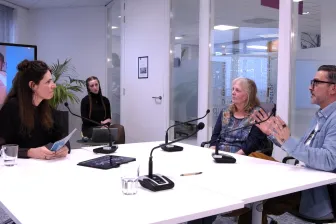
Listen to Janet's story in this podcast. (in Dutch)
Images started going around
After many attempts, she finally got an agent on the phone who was at the scene of the accident. This is when she heard that her husband was missing. “I knew deep in my heart, this is not going to end well.” After that, she didn’t hear much more, while images of the accident had already started going around. Family liaison officers from the police were a pillar of strength during this period and kept in touch with her daily. Janet went into action mode: she needed to know what had happened. “We needed information in order to understand what was going on.”
Two days after the incident, she went to Terschelling to see for herself what the situation was like. “The only thing that you wish is that he will be found and come back home.” In the meantime, she felt frozen in place. “Our life was on hold, but the rest of the world just kept going.”
To understand more, she actively searched for information and images. She visited the water taxi in the yard to see what it looked like and to get a better picture of the incident. With all these pieces of the puzzle she tried to reconstruct what had happened. At the same time, she was confronted by the role of the media. Her husband was publicly identified by name, age and place of residence. “Where is the boundary in privacy, and when did I become public property?” This made her anxious and uncertain.
On November 6th, sixteen days after her husband went missing, she received the phone call announcing that a body had been found. Once again, there was a period of waiting. In the meantime, the media exploded again, and people were already offering their condolences, while there still wasn’t any certainty about who had died. In the end, it turned out to be her husband. Identifying him was difficult because of the condition he was found in. Janet describes this as the moment she lost her husband the second time: first when he went missing and thereafter, permanently.
Conversations with others who were involved
The support from her community was of great value during this period. She felt supported by her network. At the same time, she started to process what had happened, and started to feel the need to get more answers. Through Perspectief Herstelbemiddeling, she came into contact with others who were involved. This started with a conversation with a person who had also lost someone in the accident, which helped her since they had both experienced the same thing. In these meetings there was room for both emotions and sharing perspectives on what had happened.
Aside from this, she also spoke to survivors of the accident and first responders who were at the scene. Through their stories, Janet got more insight and could form her own idea of what had happened. As she says herself: her husband can no longer say what happened, but his story can still be told through others. This helped to prevent the incident from living its own life in Janet’s head.
The conversations through Perspectief Herstelbemiddeling helped her put the pieces of the puzzle together and get more understanding of the situation. At the same time, there was something else playing a role in how she processed things: the way in which information had been shared right after the incident. The lack of support and the way she kept being misdirected should never have happened. The way in which the media shared the story also raised many questions and feelings.
“If only I had stopped him”
During the process, Janet had to deal with feelings of guilt, sadness, anger, misunderstanding and powerlessness. Thoughts like “if only I had stopped him” came along. But gradually she realized that the blame was not on her. In addition to the support she had from her surroundings, she also sought professional help in the form of EMDR therapy to process traumatic images and nightmares.
The loss of her husband also meant that she had lost a part of herself and her perspective on the future. In a short time, everything changed and a lot of fear arose, partly because of the realization that coming back home is never guaranteed. At the same time, she felt the need to do something again and contribute to society. After two to three months, she returned to work, although she later indicated that she could have used more professional guidance with this. This experience led her to choose a different path.
With the support of Perspective Herstelbemiddeling, Janet has been able to unravel the puzzle pieces of the event step by step. Her story shows how impactful a traumatic event is, but also how important it is to get information, recognition and contact with others in order to be able to understand and come to terms with what happened.
Podcast
Listen to Janet's story in this podcast. (in Dutch)